
Pushing the Print Button
The setting was public but the experience was private.

This week is a blur, and I’m trying to keep my momentum with weekly posts, so before I head out of town tomorrow to visit the Greenhorns rural Agrarian Library at the tip-top of Maine, I wanted to share something. I posted a deck about this small capsule exhibition on Instagram that I put together at Women’s Studio Workshop, where I am the archivist, when it was installed outside the library on campus this spring. I didn’t have the opportunity to share the full text I wrote or the checklist publicly, so it seems like a good moment for those of you who missed it or perhaps want a little more info about who she was. Below is an adapted version of what is available for the exhibition, and it may read a bit strange since it’s a checklist with extended labels. For the sake of time, I’m pretty much leaving it as is. If you have questions about anything specific, please reach out. Also, make sure to take a moment with the portrait of her below with her cat Muffin; check out that dreamy office bulletin board behind her. So much information within reach…
As someone whose life was altered early on by zine culture and photocopies (that’s me in the 1990s), learning more about Neaderland’s contributions and impact on Xerography as a creative tool has been nothing short of inspiring. Part of what is awesome about my job is lifting out stories to highlight WSW's fifty-year history; more on that in the future. In the next few weeks here in The Thumb Tack, expect some agrarian library finds and updates about the trip towards the Canadian border.
“Revolutions, to be successful, must ultimately engage the masses, and like the camera before it, the copier became the darling of the public.”
Louise Odes Neaderland
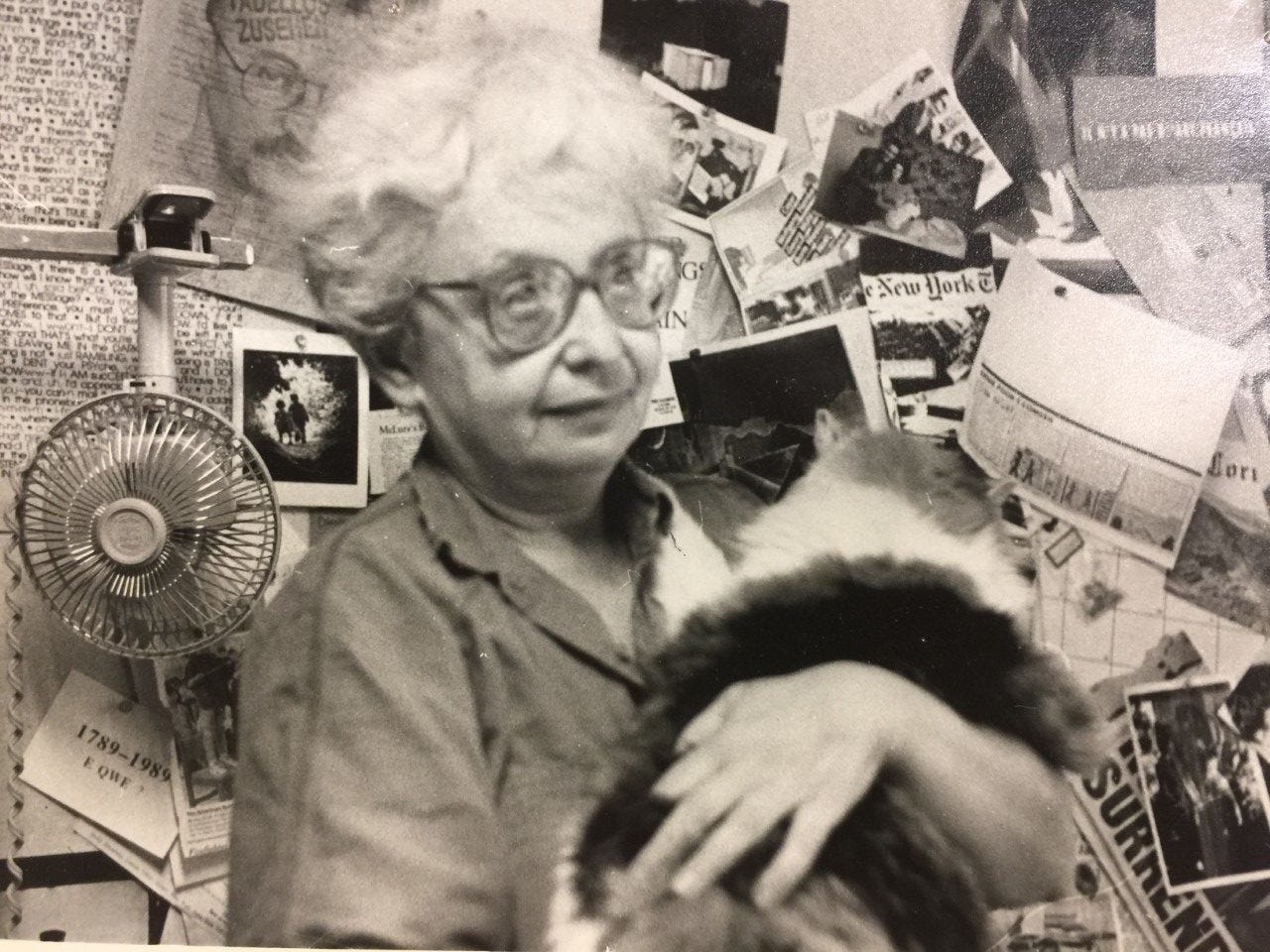
Celebrating the life of Women’s Studio Workshop alumni, Xerographer, printmaker, and book artist Louise Odes Neaderland (1932–2022), Pressing the Print Button highlights a selection of Neaderland’s work pulled from the WSW library and archive. Additional supporting materials for the exhibition were sourced from the Special Collections and Archives at the University of Iowa, where her papers are housed, giving a fuller picture of her lens for copier art and book production. Many of Neaderland’s books have conflicting publishing information listed in her personal papers and various online sources; when possible, this exhibition has defaulted to using Printed Matter’s 2023 Catalog of Neaderland’s work for a consistent source.
“The copier as camera, darkroom, and printing press was the mantra of artists who used the copier as a creative tool. All of my books were created to editioned on a copier which allowed me to enlarge, reduce, distort, degenerate, directly image three dimensional objects and, edition books and prints instantly!”
Neaderland first came to WSW to take photography classes from co-founder Tana Kellner. At the time, she was a mother of two young children working towards making art more seriously than her current practice. In the 1988 article “Artist in the Age of the Copy Machine: Louise Odes Neaderland” for Women Artists News 1988, she stated, “During the years when my children most needed my attention, I turned to woodcarving, creating carved settings for mirrors, which I exhibited and sold at craft shows in the Northeast. To qualify for ever more selective shows, I studied photography at the Women’s Studio Workshop — I needed slides to submit to juries. I began also to do some black-and-white work.” During this period, Neaderland was also dealing with the declining health of her mother. Her book, Scenic Tunnels was about this topic and included photographs from this era.
While taking photography classes at WSW, she used a photocopier to reproduce her work. In the same article, Neaderland explained, “One day, I happened to put, first one, then a series of my photographs on the Xerox machine, creating a narrative through the juxtaposition of multiples of a single image or copies of a related series. I folded, bound, or shaped them into books in small editions.”
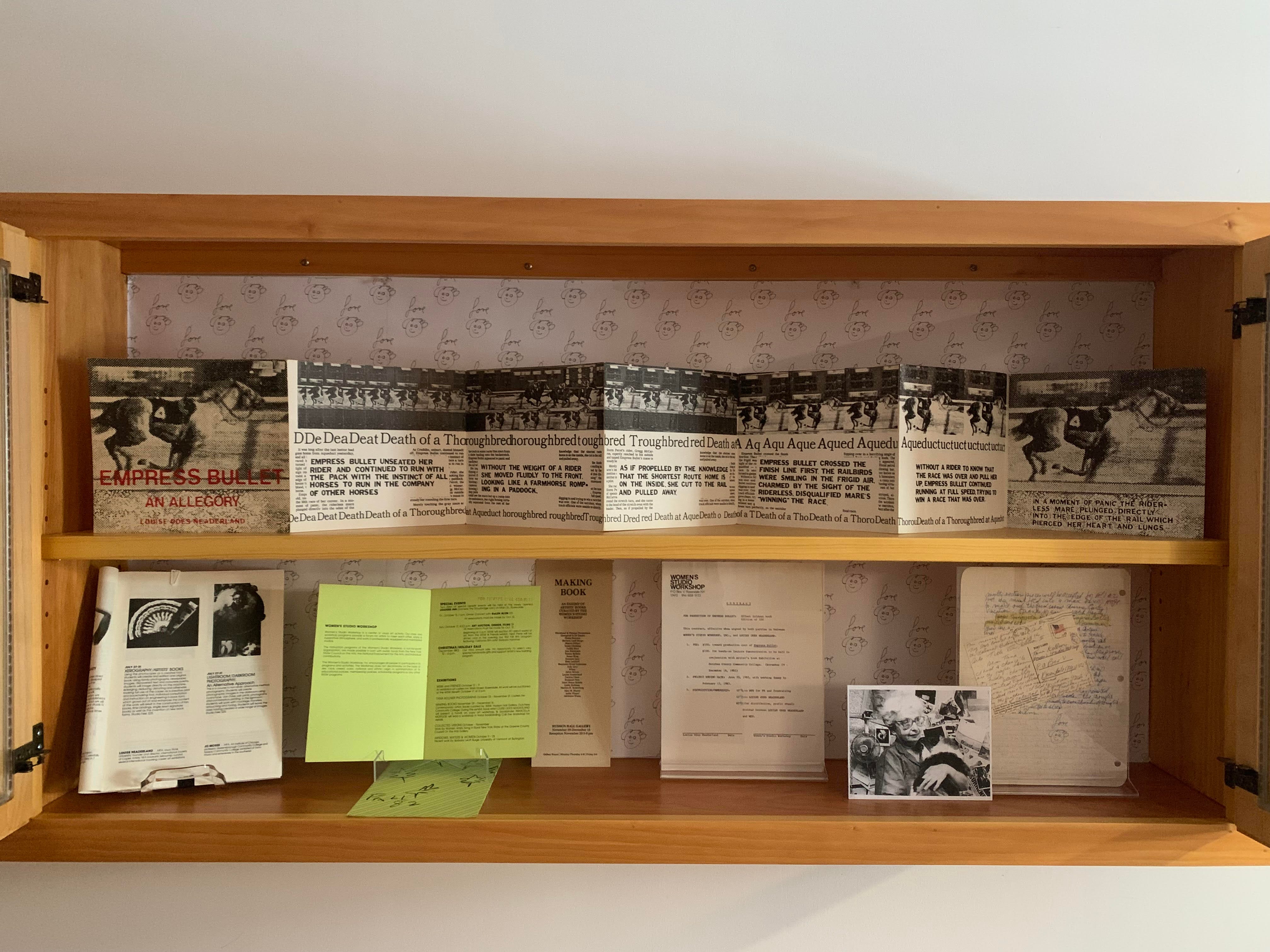
Women’s Studio Workshop, Correspondence, n.d.
Women’s Studio Workshop, Unsigned WSW Contract for the production of Empress Bullet, 1982
Women’s Studio Workshop, Fall 82’ Events, 1982
Women’s Studio Workshop, Hudson Hall Gallery exhibition flyer, Making Book, 1982
Women’s Studio Workshop, Summer Art Institute programming, 1987
Louise Odes Neaderland, Empress Bullet, 1982
In 1982, Neaderland received the WSW Artist’s Book Residency for her proposal of Empress Bullet: an allegory. The book is self-described as “A racehorse [Empress Bullet] throws her rider, goes on to cross the finish line first but is disqualified from winning because she has no rider. Without a rider to rein her in she continues running until impaling herself on a safety barrier. Created from multiples of a single image and the article's text manipulated to create found poetry.” Created from an appropriated photograph by Vic De Lucia and a New York Times article by Steven Crist.
The same year as her residency, Neaderland established the International Society of Copier Artists (I.S.C.A.) and published the first I.S.C.A. Quarterly. Two of WSW’s co-founders, Tana Kellner and Ann Kalmbach, contributed to the early issues. That same year Neaderland wrote to Kellner and shared, “The response to I.S.C.A. has been great artists sending in material and memberships from all over the country - from Switzerland, Italy and Germany. Even Xerox Corp has subscribed - I guess they figured $15 wouldn’t break them.”
The I.S.C.A. was “a non-profit professional organization composed of artists who use the copier both, alone and in conjunction with other medium to create prints, murals, billboards, postcards and innovative array of bookworks.” Neaderland continued to publish the Quarterly for twenty-one years until 2003.
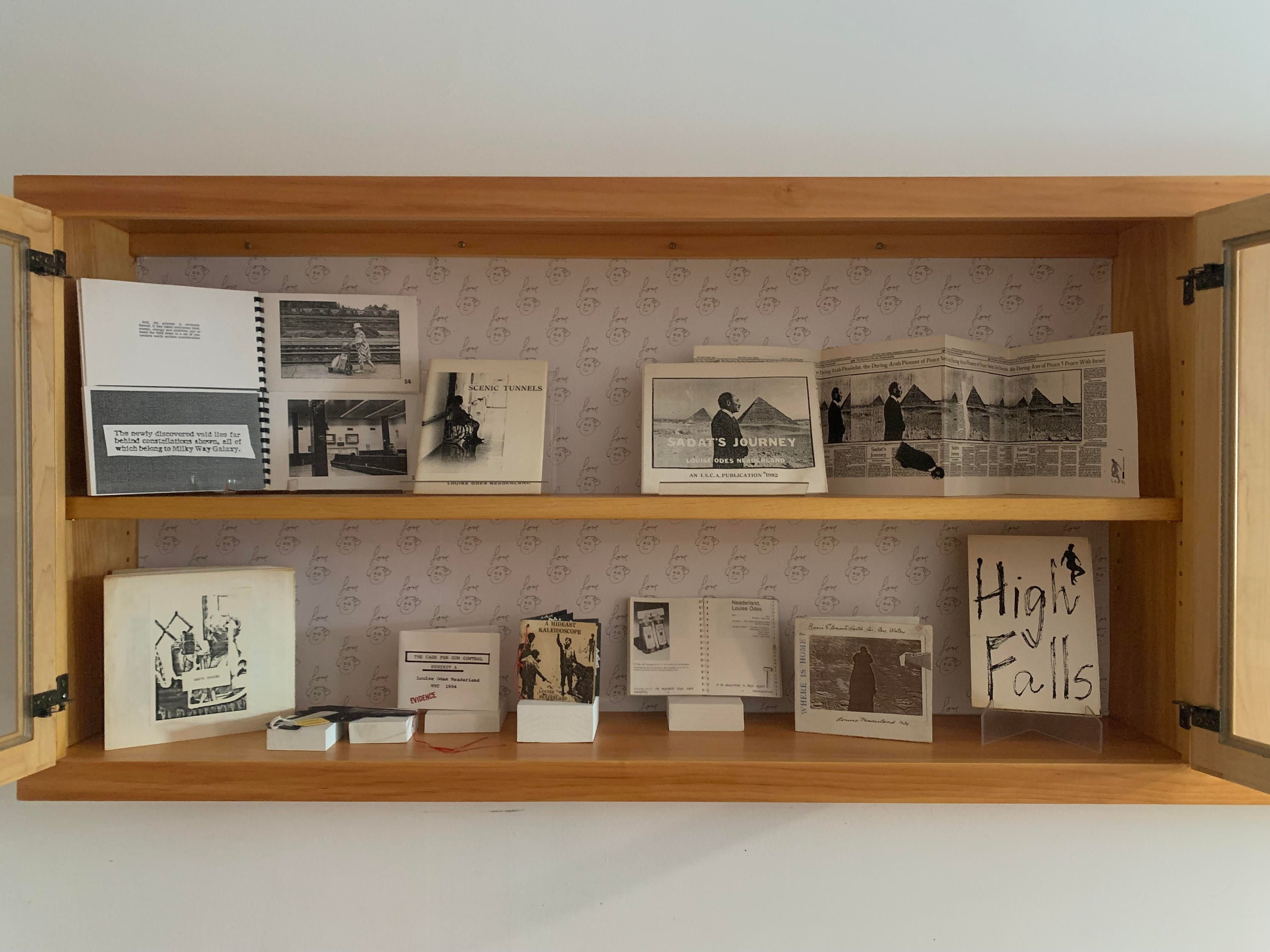
Louise Odes Neaderland, High Falls, 1981
The single subject of High Falls, a photograph taken in High Falls, NY, is less than five miles from where Neaderland was taking photography classes at WSW. This relationship to place and access to WSW directly impacted Neaderland’s career, as she explains in a letter dated March 17, 1986. She typed on the photocopied letterhead for The International Society of Copier Artists, “My first book, High Falls, consisted of five xerox copies of a photograph taken in High Falls, N.Y. The photograph was of a young man jumping from the top of the falls into a deep pool at the bottom. By cropping each of the copies of this photograph so that the first showed a great deal of white sky and the last a great deal of black rock, an illusion of movement or animation was created when the five copies were strung together vertically. This was my first accordion wall book. All of my subsequent books (25 to date) have each been created from altered multiples of a single images. Using this mention I discovered that less (one image) was more because the images was so intensely explored.”
“Many of us encounter our first copies, coin operated machines, in the early sixties. These machines could be found in supermarkets, post offices and libraries. The setting was public but the experience was private.”
Louise Odes Neaderland, Where Is Home? Basic Elements: Earth, Air, Fire, Water, n.d.
Neaderland held an MFA in Printmaking from the University of Iowa, where she gifted her papers in 2003 to the Special Collections and Archives, and a BFA from Bard College. She produced over 60 artists’ books, and many are in special collections at MoMA, the Metropolitan Museum of Art, Getty Center, Sackner Archive, and Museo Internacional Electografica. Neaderland taught workshops on using the copy machine as a creative tool.
Women’s Autobiographical Artists’ Books, Exhibition Catalog, 1987. University of Wisconsin-Milwaukee, Curated by Pamela Zwehl-Burke and Leslie Fedorchuk
The exhibition catalog, designed to mimic an address book, features the 90 participating artists, including Neaderland. Alphabetized with additional entries interspersed by the curators such as “Notes on the Women’s Art Movement” pages 94-95, “Notes on the Development of the Artists’ Book” pages 150-151, “Initial Notes – Forms of Autobiography” page 196-197, and “Addresses of the Artists and Curators” included as backmatter.
“The intention of Women’s Autobiographical Artists’ Books is to present the range of visions that women have used in representing themselves, and their experiences, through the form of the artists’ book – pushing the definition of both “autobiography” and “artists’ books” in many directions.” Musings on the coming together of the women’s art movement, the artists’ books, and the impulse toward autobiography, Zwehl-Burke and Fedorchuck.
Louise Odes Neaderland, A Mideast Kaleidoscope, 1983
Louise Odes Neaderland, The Case For Gun Control, 1994
Featured as the artist of the month at the Center for Book Arts in 2000, Neaderland reflects on 18 years of book publishing, “My work has almost always been involved with social, political, time, and space issues. I deeply believe in art as communication and that artists can help to make the world a better place through social and political comments in their work. In recent years I have been particularly involved with developing and utilizing book forms that encourage the viewer to interact with the book to expose its’ multiple configurations.”
Louise Odes Neaderland, Empty Spaces, 1981
Louise Odes Neaderland, Sadat’s Journey, 1982
Memorializing the Egyptian president Anwar el-Sadat, assassinated in October 1981, Sadat’s Journey incorporates a photograph by David Hume Kennerly and parts of text from a New York Times article. The photocopy collage is consistent with Neaderland's repetitive use of images throughout this period of her production.
Louise Odes Neaderland, Scenic Tunnels, 1983
Louise Odes Neaderland, Missing Persons, n.d.
“For much of its history copy art has been thought of as throw away or ephemeral art. Sometimes it is that and serves and important function in just being that. There is also, however, a group of serious and committed printmakers and book artists who see the copier as another print medium as unique in its way as woodcut, etching and silkscreen for the production and editioning of fine art prints.”
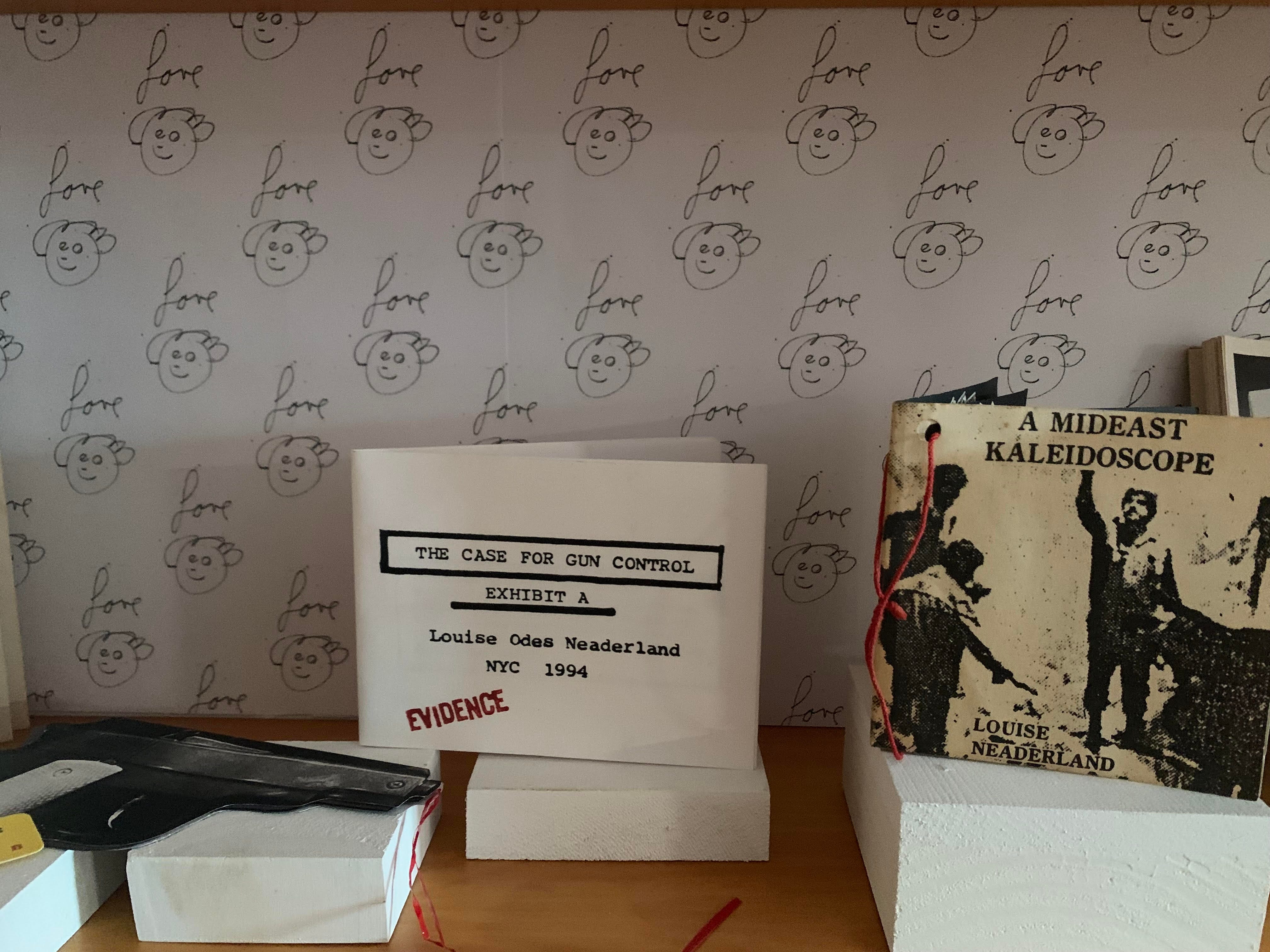
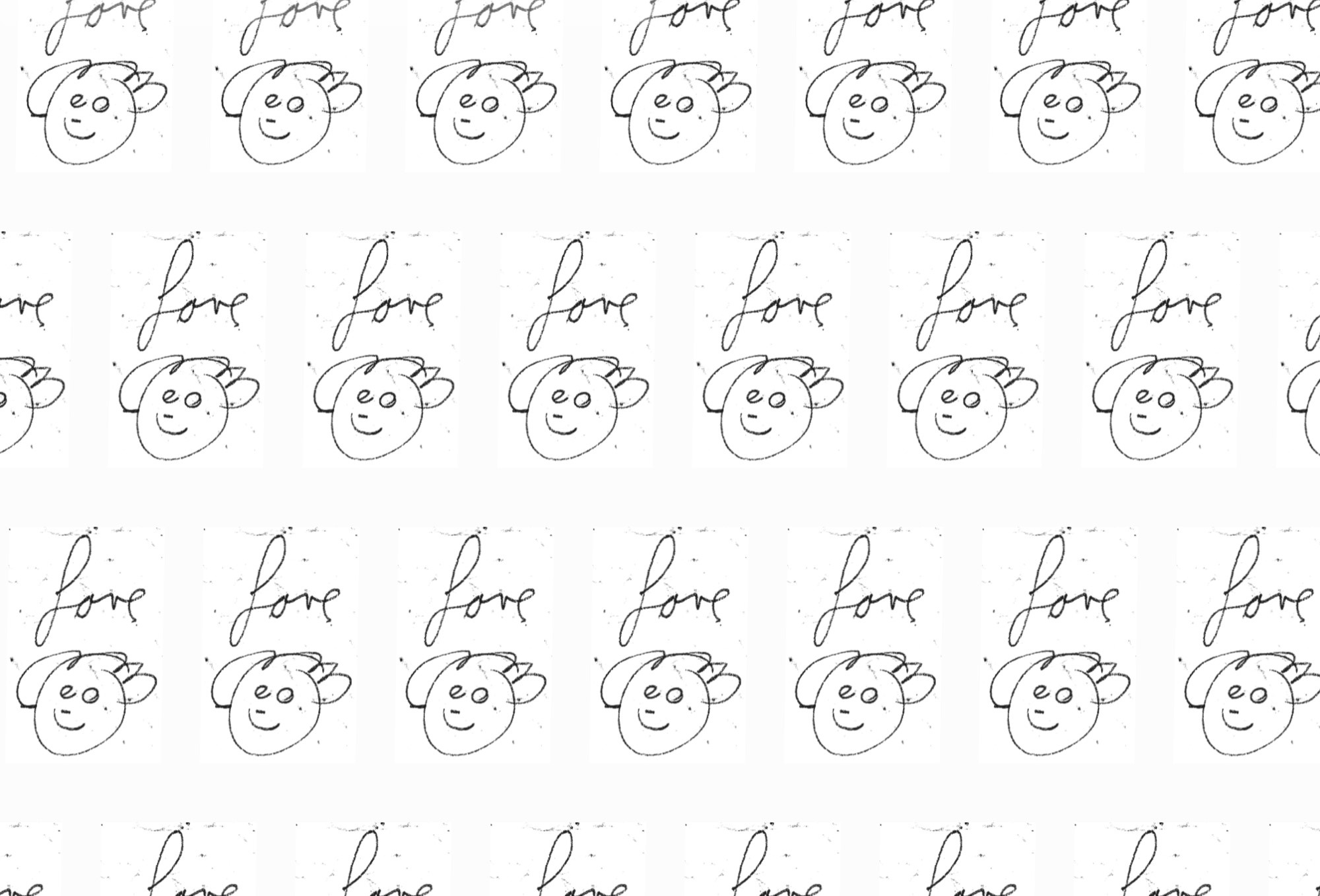
The playful all-over-print exhibition wallpaper is inspired by Neaderland’s cheerleading for the use of multiples and was designed to honor her smiley caricature “signature” used when signing off her correspondence with WSW founder pulled from correspondence in her artist file.
Interested in learning more? Read this great piece via Special Collections and Archives at the University of Iowa where Neaderland’s papers are housed along with the full catalog of the International Society of Copier Artists (I.S.C.A.) and other mail art.
Recommended related reading: Adjusted Margin: Xerography, Art and Activism in the Late Twentieth Century (MIT Press) by Kate Kate Eichhorn.
Let us all be inspired by multiples and their use as a tool for liberation for all people.