
Translating Everything Into Something Else
Betty Ruth Curtiss & my first Riso class

“She would make Xerox copies of sneakers, make beautiful postcards, and stationery.”
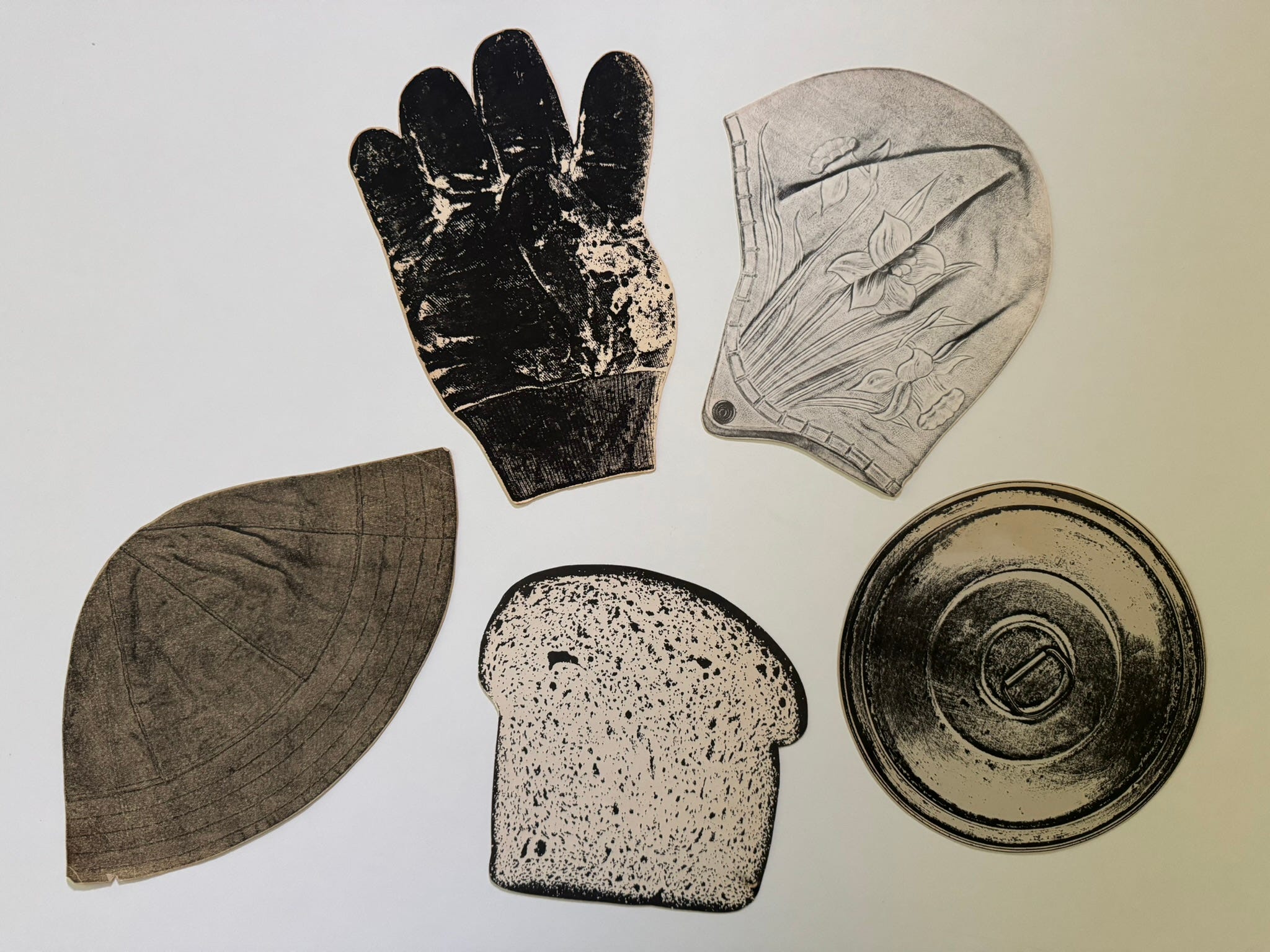
Like most things I’ve been writing about recently, this story starts with finding something in the archive. A few years ago, at work, I was sorting through boxes of loose, unorganized materials (zines, artist books, and ephemera) that had been tucked away for an unknown number of years. This is part of a larger indexing project I’m chipping away at in order to make all of the organization’s materials searchable. I have to be mindful not to get fully derailed by everything I become interested in. But some things do get set aside for more inquiry, some stick around even longer for further obsessing. This is one example of further obsessing. Loose, turning up in various places, with no information except the same rubber stamp on the back: Xerographic Postcard ——— By Betty Ruth Curtiss.
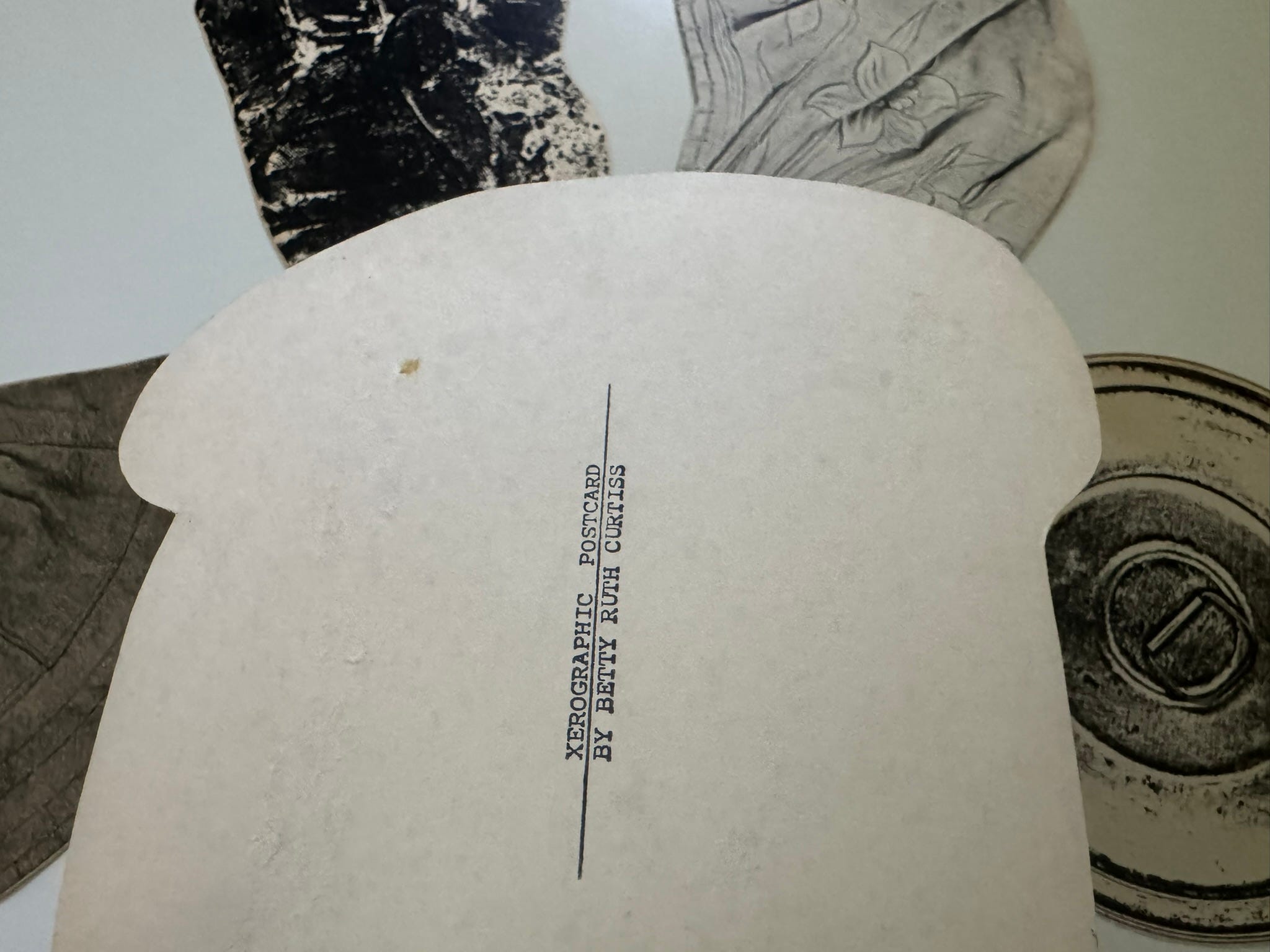
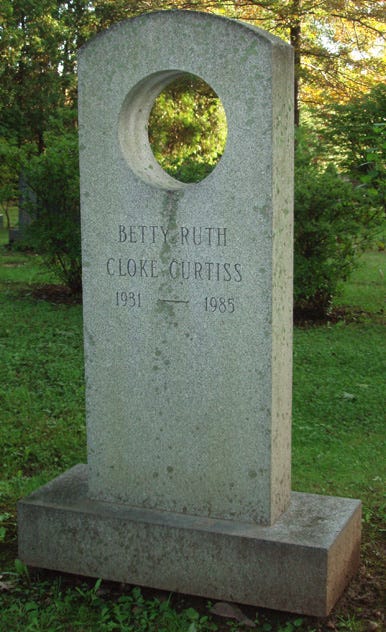
There are five in total, all out of scale, black-and-white, printed on cardstock: a bucket hat, a glove, a swim camp, a slice of bread, and a trash can lid. All perfectly cut, presumably by hand. They are perfect. I was instantly obsessed. Who was she? Spoiler: Betty Ruth Curtiss passed away in 1985, at the age of 54. If you are curious about the details, after a quick search, I found a link to an incredibly mysterious post that shares more, but also felt like an extension of my experience of stumbling across her work. The tl;dr: the author (who discloses she also made art at the time, in 1991, on a Xerox machine) stumbled across a gravestone (see below), became intrigued, and went on to learn about Curtiss’ life retroactively. He found an obit that disclosed, “She was vice president of the Arts Council of Princeton and a member of the Princeton Art Association, the International Society of Copier Artists, the Printmaking Council of New Jersey, and the New Jersey Designer Craftsmen.” Putting a pin in this because it’s all connected. The International Society of Copier Artists (ISCA) is the organization I wrote about in 2024, which Louise Odes Neaderland ran, and the subject of a 2028 exhibition I’m co-curating that will open at the San Francisco Center for the Book. The article went on to say, "She would make Xerox copies of sneakers and make beautiful postcards and stationery.”
I emailed the author. He never responded. Skip ahead to this summer.
Working at a feminist arts organization has perks. Most of them shouldn’t be considered perks, but in this climate, pointing out the obvious is important. As part of our professional development and a hands-on way to better understand our studios, staff are encouraged to take a summer intensive class through our 40+ year-long Summer Arts Institute programming. This is the first year I’ve had capacity, and I decided it was time to use a Riso printer. I’ve been consuming independent media they've printed since 1995 (I narrowed the year based on a great post by Xander Marro that triggered a memory of my first Riso-printed book, Not For Rent, which I’ve reacquired since). All to say, I have a lot of Riso materials in my personal library, I know some epic Riso folks who have changed the way we consume and view printed materials, and I have access to a machine. Still, I was intimidated.
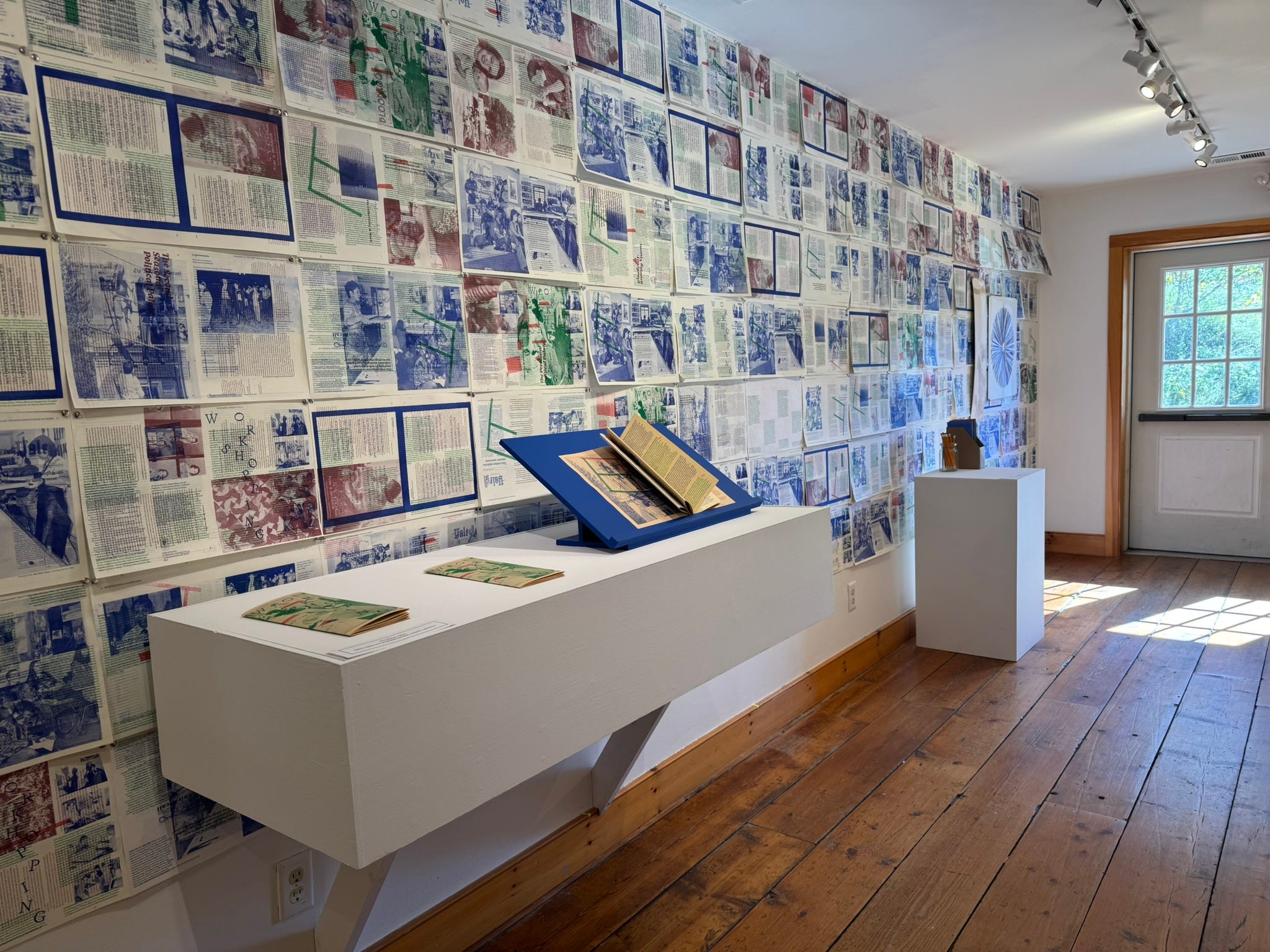
I kicked off July with Riso Ephemera: Printing the Day with Emily Larned. I’m now realizing I never wrote about WORKSHOPPING, Larned’s exhibition at Women’s Studio Workshop, which I curated towards the end of last year. My job security was in the air due to funding cuts, and it had the potential to be my last exhibition before I dipped out. It was a stressful few months, and some things fell between the cracks. The outcome of the gorgeous exhibition and her time in the archive at WSW was a Riso publication that is a great example of how to creatively work with archival materials. Truly a win to support this work, and I was thrilled to be in a classroom with her since I knew it would be a supportive environment regardless of my skill level. I was right.
It’s been years since I've taken a class, and I couldn’t have asked for a better experience. Emily’s teaching style, paired with my cohort, was a dream. It was so cool to hear the different reasons folks took a week out of their lives to come to WSW and spend time making art in community. Emily gave us daily prompts with no pressure to finish or start anything particular, just different entry points for learning and creatively thinking about ephemera, multiples, colors, folding, cutting, and sharing. I was the only person in class who had never used a Riso. I was also determined to “finish” something because I am cursed with unfinished projects. We were asked to bring things to work with. The class description stated, “In attending to the now and now and now, you will collaborate with paper, the riso, and the contents of each day as a vital way of life: responding to the moment through making.” I brought a folder of materials from my genealogy work, thinking I would finally start thinking through a project I’ve been sitting on for a few years. Then Betty Ruth Curtiss popped into my head. A great example of being haunted. It was time to call her in.
A Game of Something From Nothing
I went back to the essay I had found, marveled again at the synchronicity, but knew there had to be more. And it wasn’t a lot, but there were a few breadcrumbs, like a goldmine 1987 NY Times review by Patricia Malarcher, Crafts: Turning The Underside Right Right Side Up, of a Franklin Furnace exhibition. In the article, the author quotes Curtiss once saying, “Frankly, I don’t like housework, I think that I have worked out a way to tolerate the tedium of this necessity by mentally translating everything into something else…” The author goes on to credit her as one of the “first investigators of the art-making possibilities of Xerography. Food, rumpled laundry, and all sorts of found objects were among her sources of imagery.” The exhibition, which “affirms that what Ms. Curtiss called a game of something from nothing,” was curated by her daughter Lisa Crosby and Dick Torchia, cited in 1987 as the former instructor of Xerography at Pratt and director of City Without Walls in Newark. The exhibition didn’t just include her Xeroxed work, but also assemblages such as “Garbage Can Band,” which included old posts, car accessories, and stove parts. It’s unclear if you were allowed to play it in the gallery. Based on photo documentation, guests were encouraged to play the piece. There was an installation of grouped objects, including dozens of household-cleaning bottles and layers of collected dryer lint. This leads me to believe that her daughter recognized the value of her mother’s vision and saved everything. The show opened two years after she passed away. I will mention that I tried to locate Lisa, and if this brings me to her, that would close the loop. I would love to tell her that her mother has inspired me and paved the path for so many of us to come.
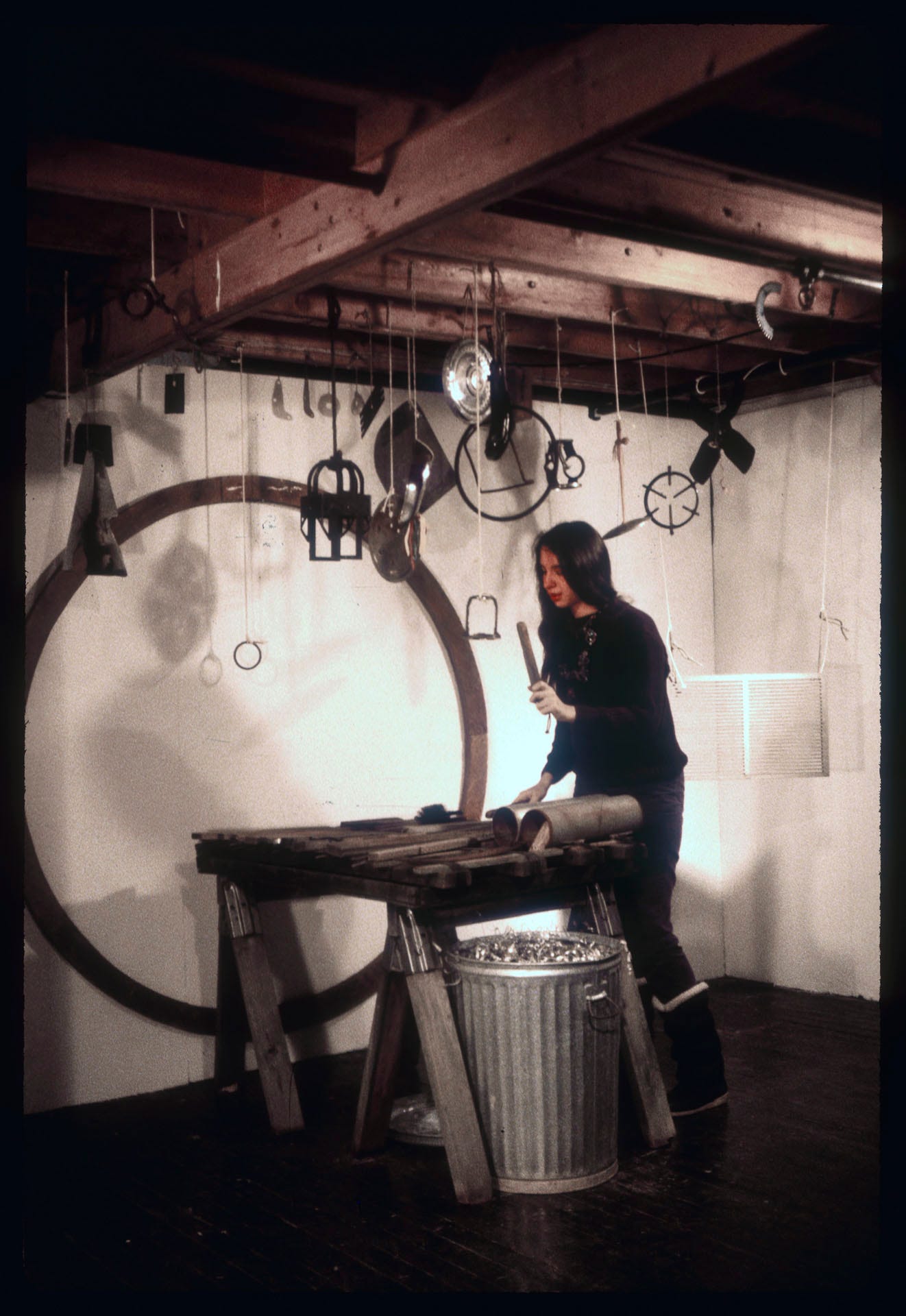
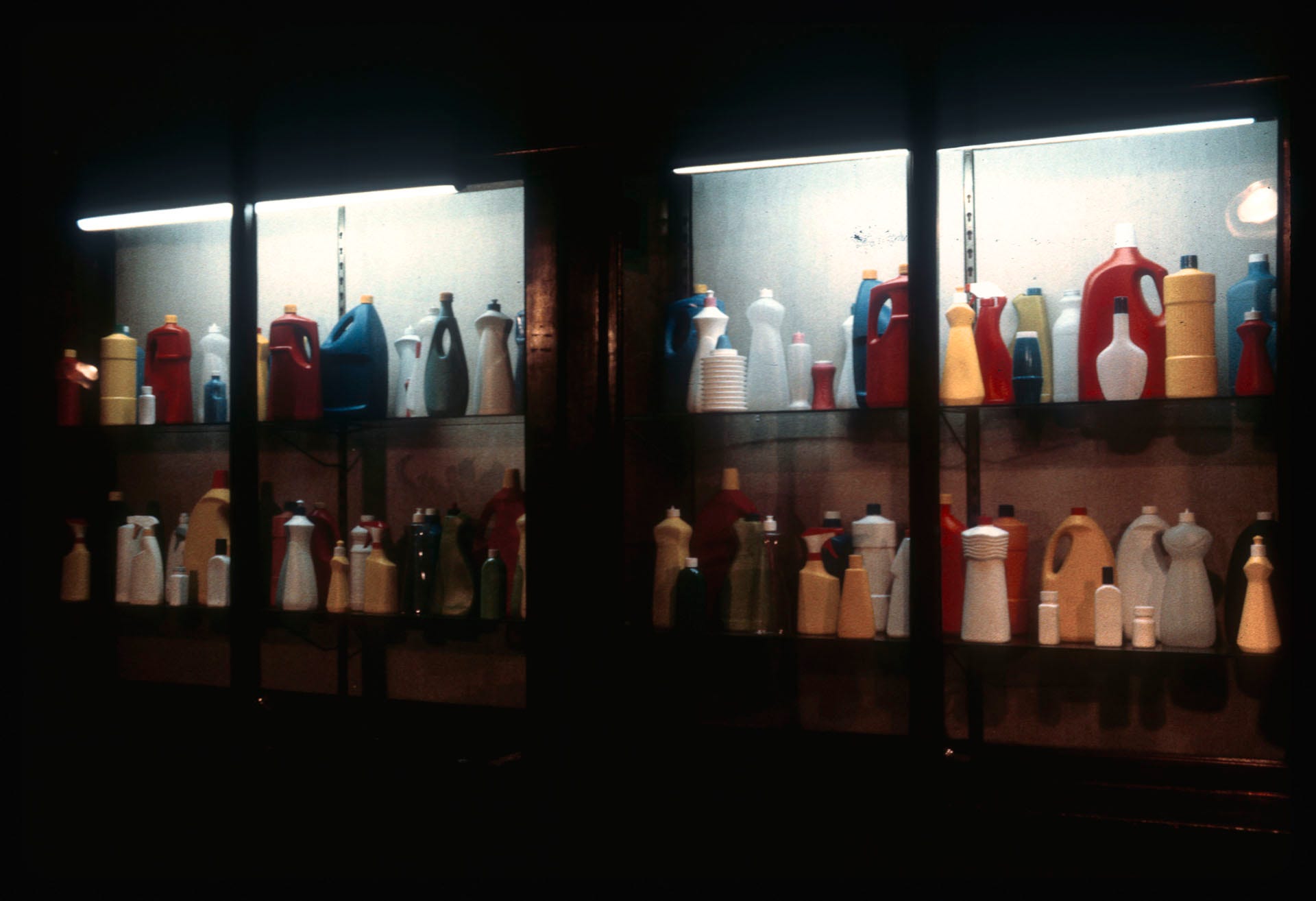
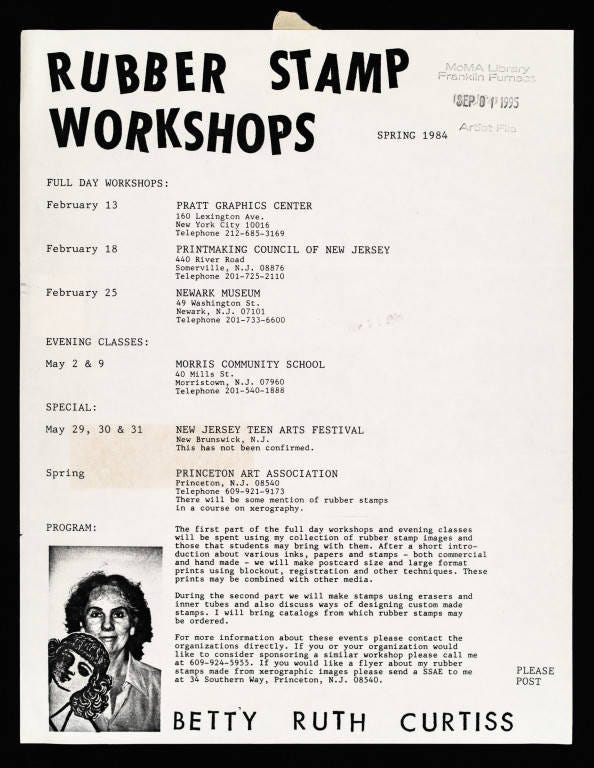
Anyhow, learning there was a show at Franklin Furnace led me to their highly functioning online archive. Here, not only did I find incredible photo documentation of the exhibition, but also the exhibition invitation, catalog, and press release, which described Curtiss as “Motivated by a way of seeing that transformed grease in a frying pan into a moonscape.” In a separate digitized section, I found additional promotional materials, including this mailer for her many rubber stamp workshops.
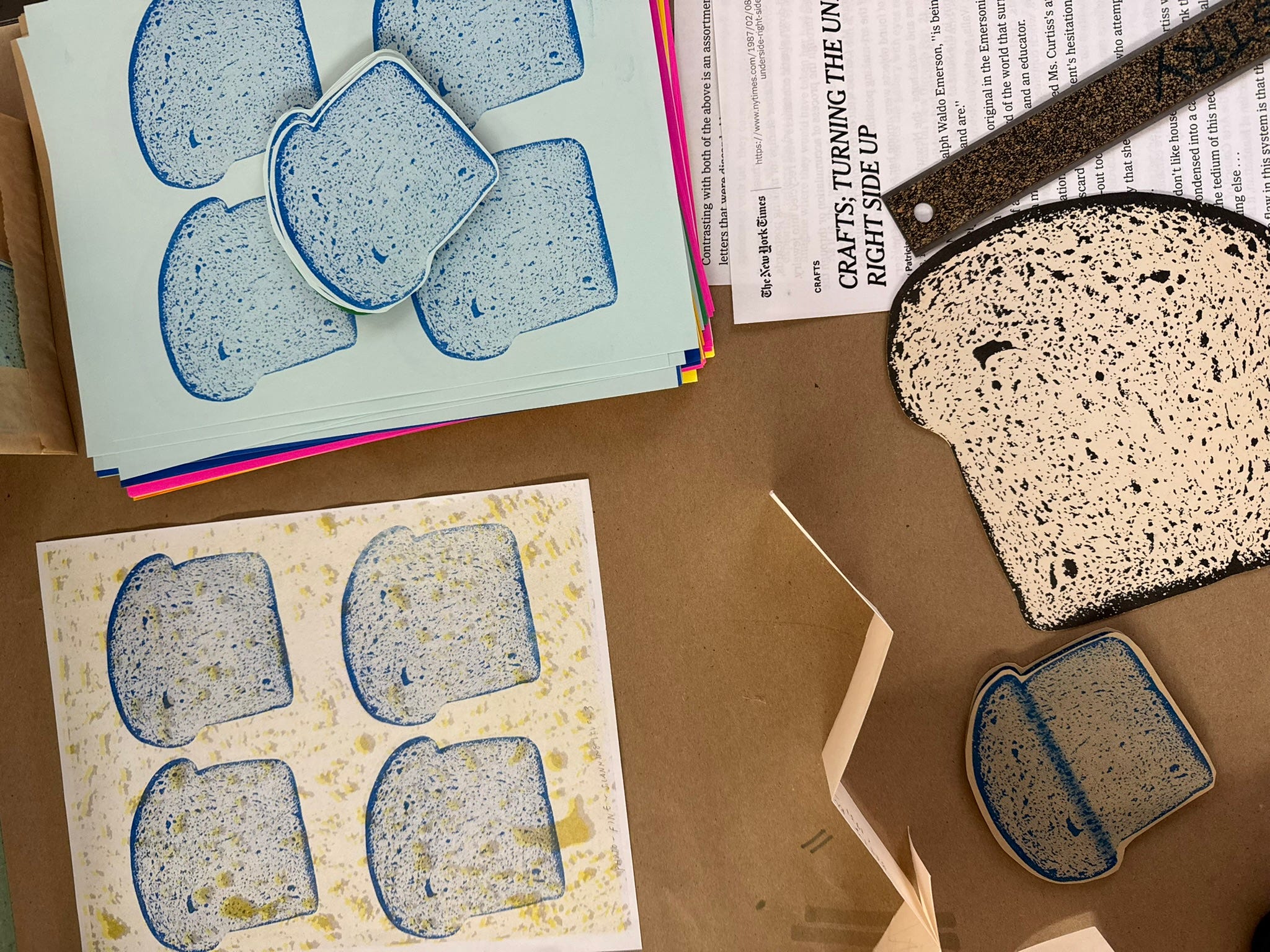
In honor of Curtiss being a kindred spirit, I scanned her slice-of-bread postcard, scaled it down from “too big” to “too small,” and made my first Riso project in her honor. A small open edition of 3 color hand-cut bite-sized accordion-folded sandwiches. I feel really, really good about the outcome. A few of you should expect one in the mail. Reach out if you need one; they are here until they are gone.
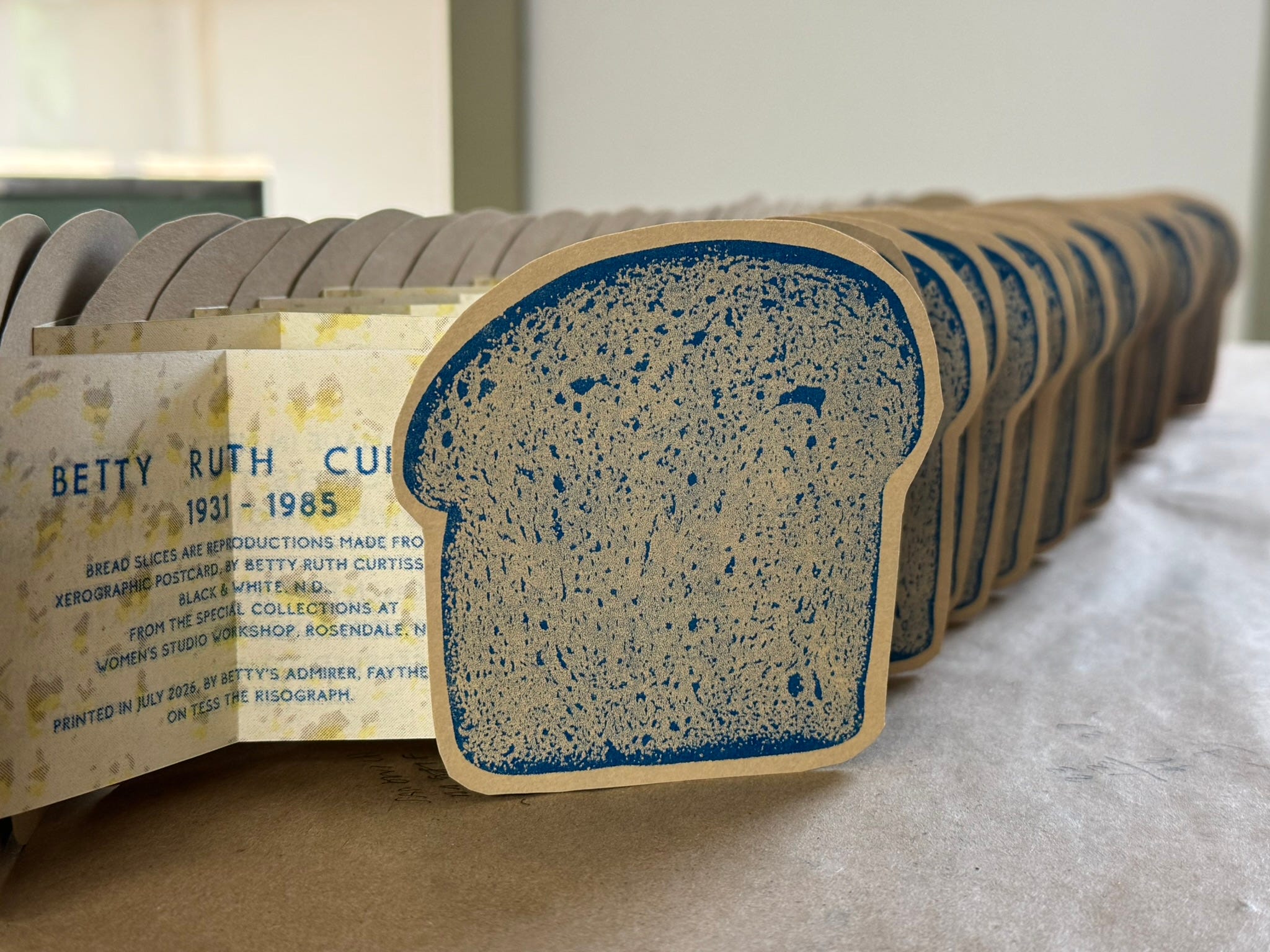
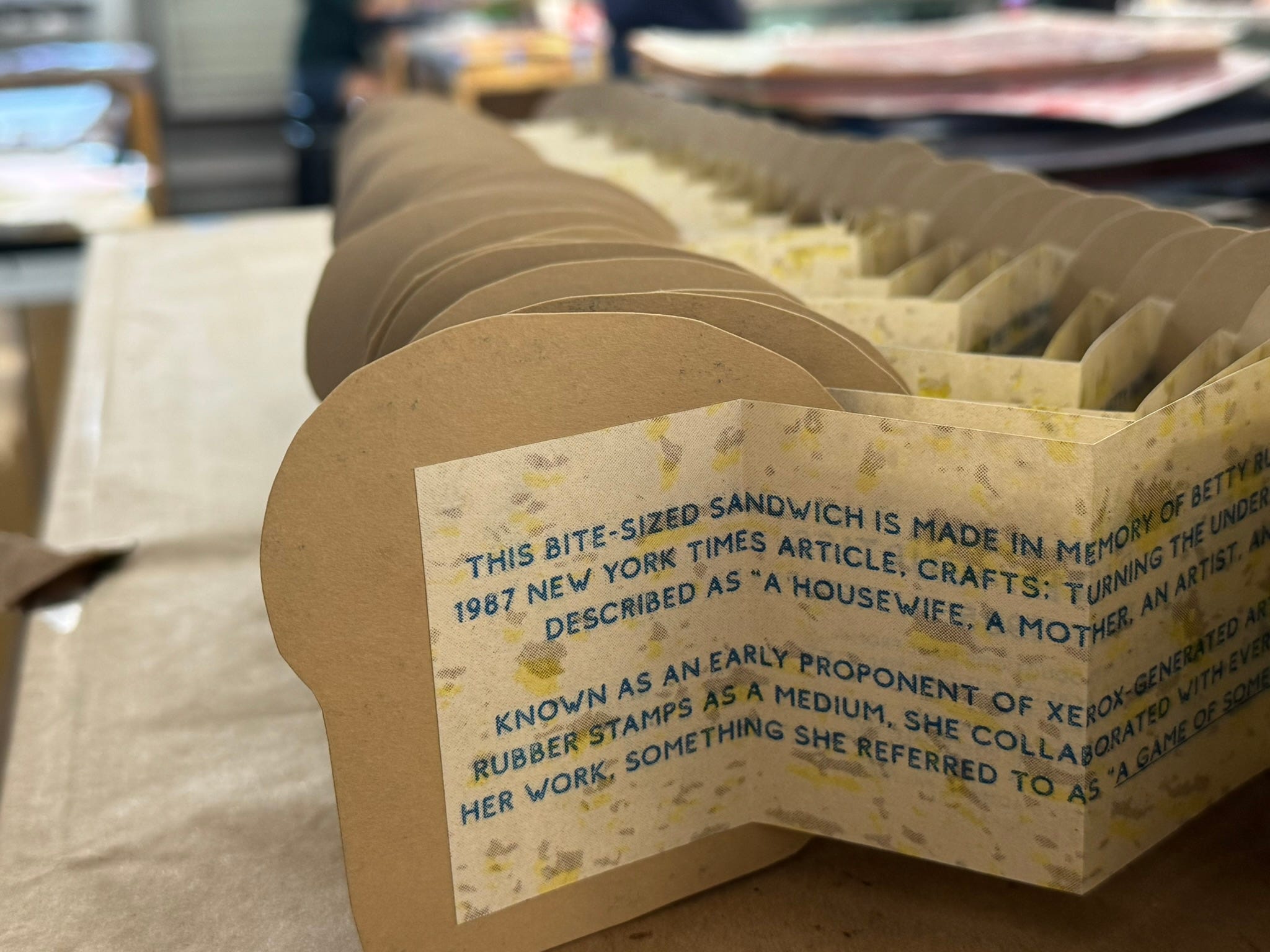
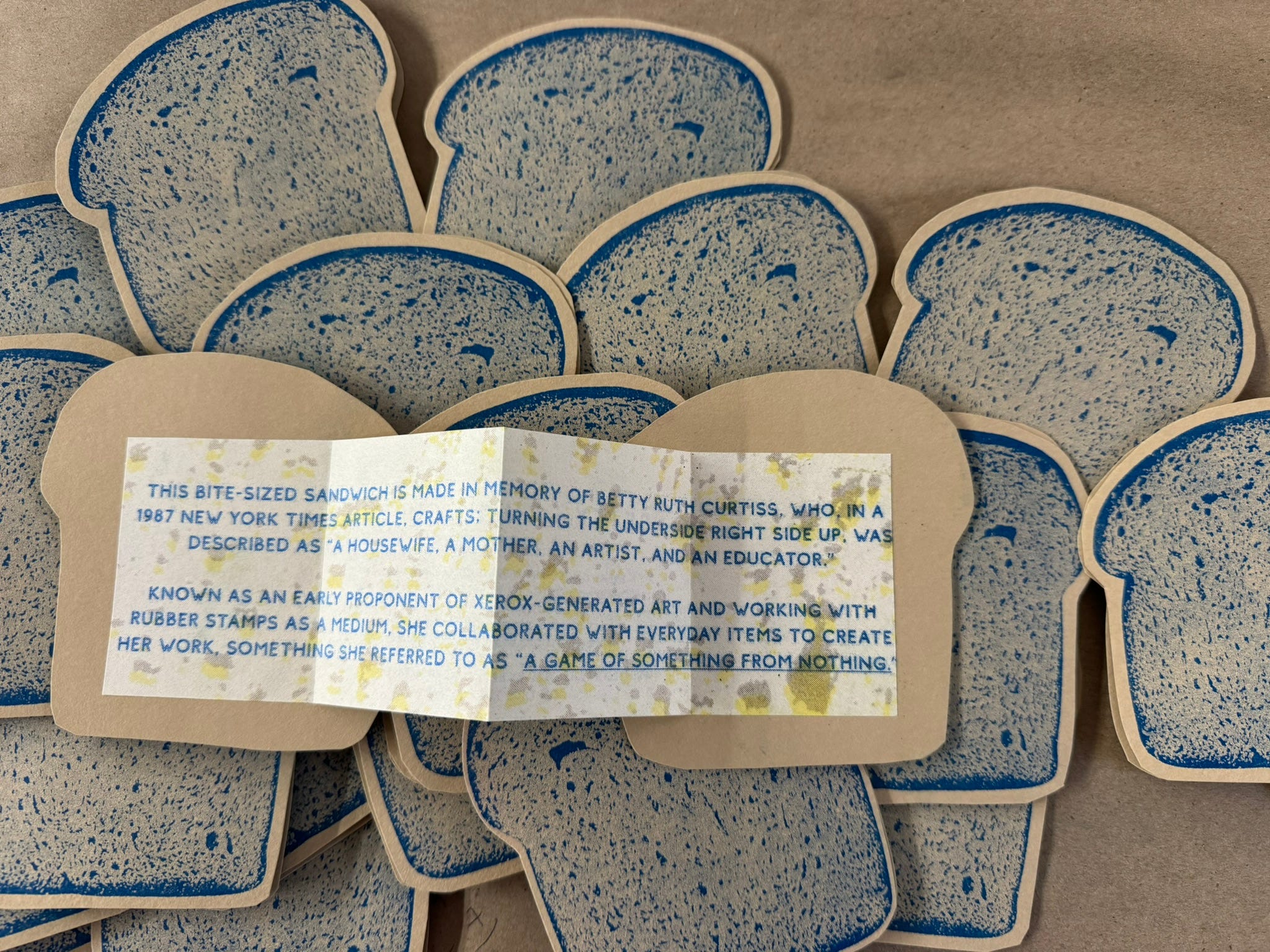
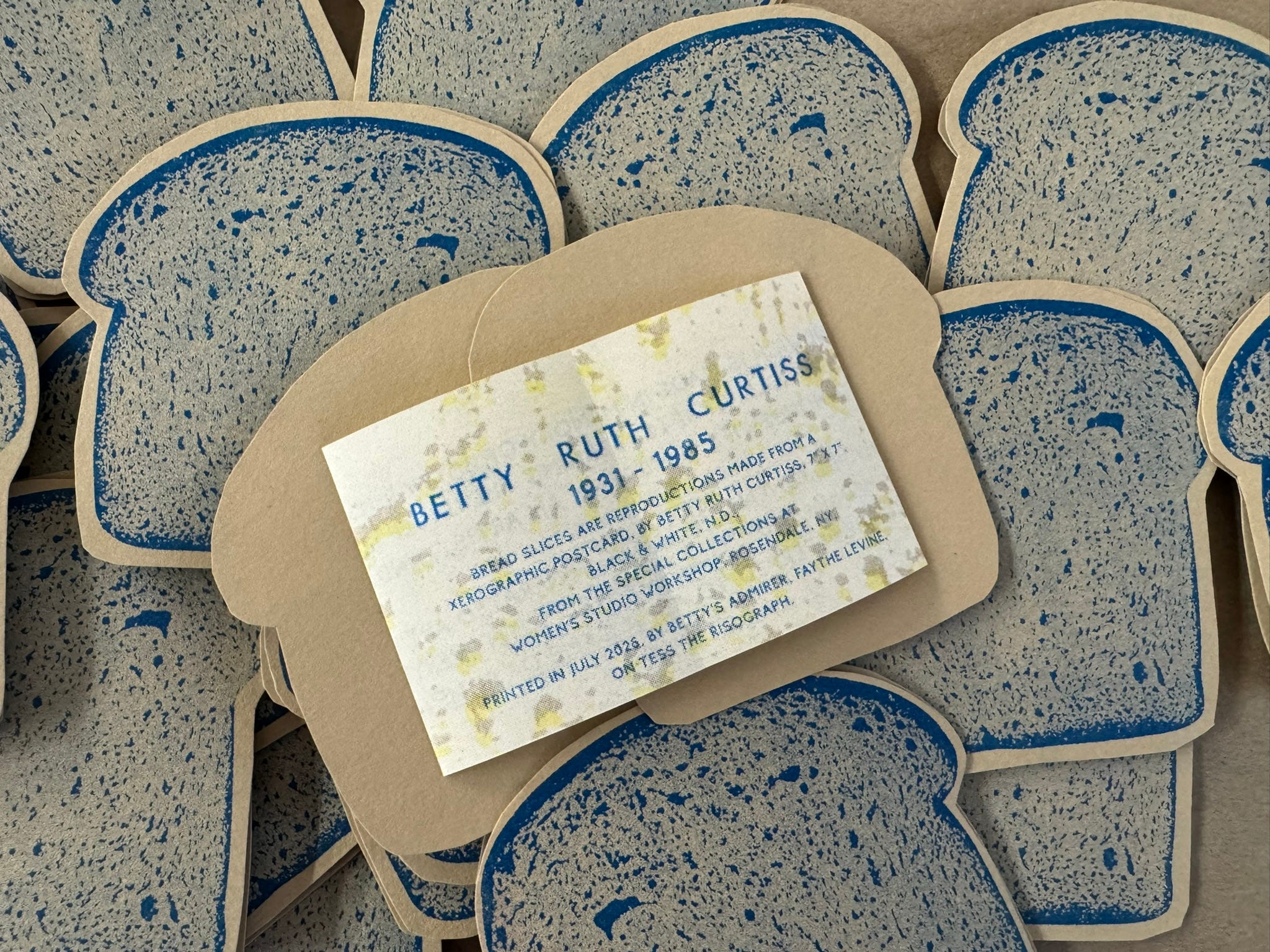
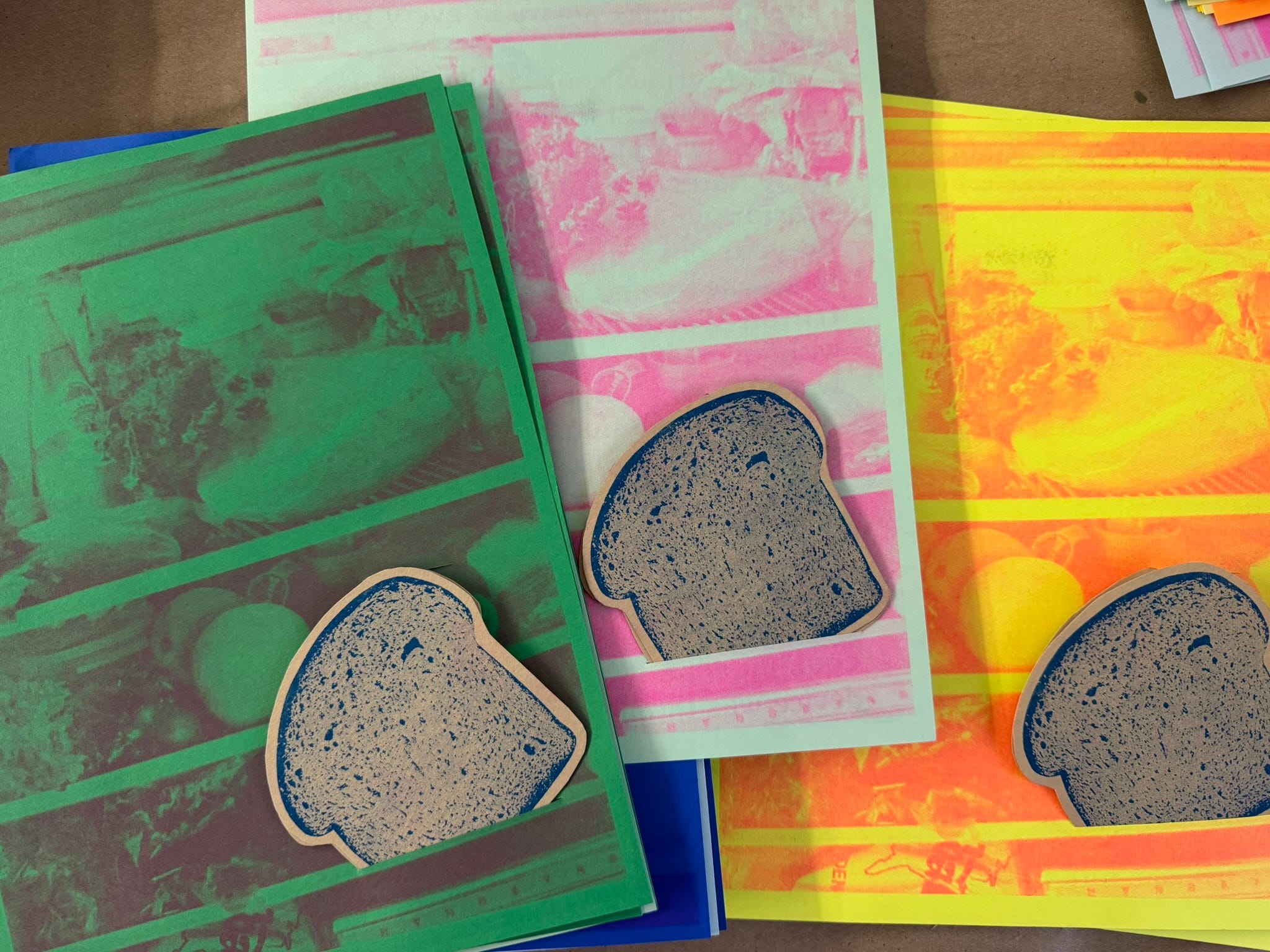
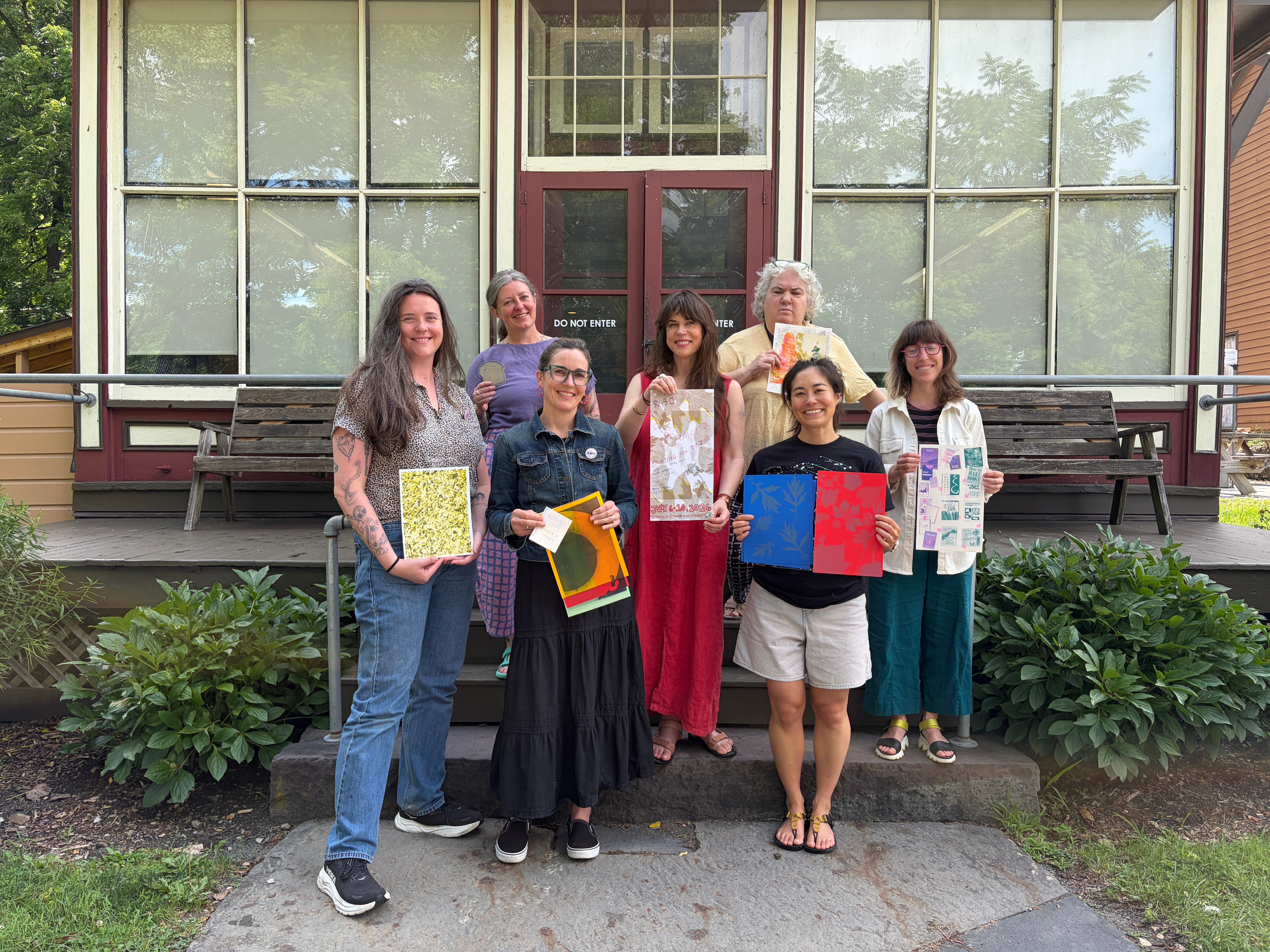
Thank you, Emily Larned. Thank you, Betty Ruth Curtiss (1931-1985). Thank you, cohort of lovely humans. Thank you, job, for giving me opportunities to learn and appreciate others. I just needed to lean into the positive this week cause, wow.
Faythe, love every nook and cranny of this bread-lined rabbit hole. My time at WSW always turns out to be absolute magic, and that is in no small part due to you and yours.
Printing from the archives! A stencil of a stencil!
I didn't realize you were in Emily's workshop! I was on a video call with WSW a week before to fix an issue that the riso you used had been having. It needed a little extra hand holding to make a stencil properly. We found a misplaced spring—which likely had been a factory assembly mistake. So when you got to use it was one of the first few times it had been its full self—wandering around and making copies on its own power.